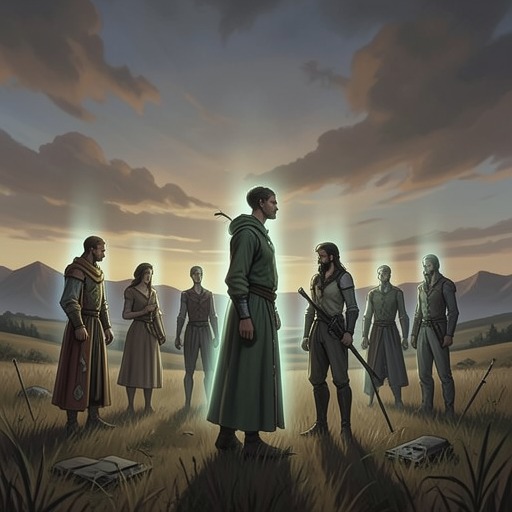
Unclaimed Hills
The Way of KingsThe Unclaimed Hills are a broad, politically ungoverned region of Roshar where survival depends on movement, adaptation, and caution. Their roads are not built roads but temporary passages across living, storm-hardened terrain; their remoteness weakens Vorin law; and their scattered settlements make them both a destination for exploited labor and a corridor connecting distant peoples, armies, and information.
Terrain and Storm Ecology
The Unclaimed Hills are presented first through the slave wagons carrying Kaladin Stormblessed. Around the rattling convoy, the apparently open grassland withdraws into countless pinprick holes in the stone as the wagons approach, then cautiously rises again after they pass. The wagons therefore travel along what looks like an open rock highway cleared specifically for them, an uncanny road produced by the behavior of the land itself rather than by human construction.
The region lies far enough into the Unclaimed Hills that its highstorms are exceptionally powerful. Plants survive by learning to brace themselves and weather the storm, making the landscape an image of endurance under repeated violence. That ecological fact echoes the condition of the people moving through it: survival is not presented as comfort or triumph, but as the discipline of remaining intact when the environment offers no protection.
Lawlessness and the Slave Trade
The hills are ruled by nobody. Their independent coastal cities are sufficiently remote that Vorin rules governing slavery are little more than distant rumors, allowing traders to move human beings beyond the effective reach of the institutions that nominally regulate them. Kaladin travels among slaves who are weak, sickly, underfed, and often repeat runaways; he is the only one marked with a shash brand. Because the group is considered the lowest and most worthless part of an already devalued caste, the captives were purchased cheaply for resale in a remote labor market.
This commercial route exposes the economic geography of the Unclaimed Hills. The region’s political fragmentation does not mean freedom for everyone; instead, it creates places where desperate cities can receive cheap labor and where distant law has little practical force. The wagons carry both people and the logic of exploitation into spaces where accountability is difficult to enforce.
The journey is dangerous even for the slavemaster. By cutting across open country and avoiding established trade routes, Tvlakv risks encountering unemployed mercenaries who may kill a slavemaster and his slaves to steal a few chulls and wagons. The same absence of authority that protects the trade from scrutiny also leaves every participant exposed to predation. The hills thus operate as a zone where ownership, transport, and violence are all unstable, and where the question of honor is made painfully concrete by the men willing to slaughter for profit.
Military Geography
The Unclaimed Hills also contain major military concentrations. From a rise, Kaladin sees smoke and then an enormous army encampment rather than a city. Ten masses of troops occupy vast, craterlike rock formations whose jagged sides resemble broken eggshells. The arrangement follows familiar Alethi military patterns: camp followers occupy the outskirts, mercenaries form an inner ring, citizen soldiers are nearer the center, and lighteyed officers stand at the heart of each encampment.
This view transforms the hills from a landscape of exile into a strategic theater. The same open distance that enables slave caravans to evade trade routes can also accommodate armies on a massive scale. Yet the camp is not a settled city. Its circular organization, craterlike shelters, and visible hierarchy show a temporary military society imposed upon difficult terrain, with protection from the storms and separation between ranks built into its physical arrangement.
A Corridor Between Regions
Although the hills are described through Kaladin’s captivity, their significance extends beyond that single route. The surrounding geography belongs to a wider network of travel and exchange. At the Purelake, Ishikk moves through shallow, transparent water that stretches for hundreds of miles, while merchants elsewhere carry unusual metal goods from distant lands. Accounts of Sesemalex Dar describe a southwestern city built in giant troughs, protected from highstorms by raised lips and drainage cracks and functioning as a major waypoint for exotic travelers.
The Unclaimed Hills therefore belong to a world in which terrain dictates political and commercial form. Storms shape plants, cities, roads, and military camps; distance alters the reach of law; and travelers connect places that maintain different customs, religions, and rules for foreigners. The region’s remoteness is not isolation in an absolute sense. It is a condition of uneven connection, where people and resources circulate while authority remains fragmented.
Narrative Significance
The Unclaimed Hills serve as a threshold between former identities and uncertain futures. Kaladin enters them as a branded, resigned slave who believes that every person he has tried to protect has died. The land’s central demand—to brace, endure, and learn to survive—matches his emotional state, while the sudden revelation of the army camp opens a possible connection to the military world from which he has fallen.
The region also reflects the book’s larger pattern of concealed systems beneath apparently empty spaces. Grass hides in stone, armies occupy hollows instead of cities, and distant settlements operate beyond the practical reach of established law. What first appears to be wilderness is structured by biological adaptation, commerce, military hierarchy, and the movement of strangers. The Unclaimed Hills are consequently not merely a backdrop for captivity; they are a borderland where the violence of social order becomes visible precisely because formal order is absent.